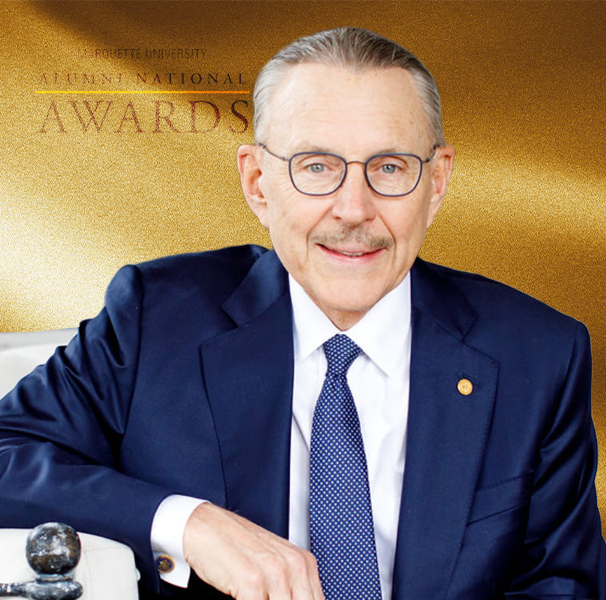
Professional Achievement Award
Ambassador John Rakolta, Jr., Eng ’70
Detroit, Mich.
"Who we are cannot be separated from where we’re from." When Ambassador John Rakolta, Jr. quotes Malcolm Gladwell, he's not speaking abstractly. He’s describing a tangible philosophy that took root at Marquette and has shaped his leadership, his faith, and his approach to understanding and serving others.
Rakolta believes that our nation and the institutions that educate its citizens stand at a crossroads that will determine whether we move forward enlightened by our differences or slide backward into a new kind of stone age. This belief is not abstract. It is the lens through which he has approached leadership throughout his life. Across business, civic life, diplomacy, education and culture, Rakolta has shown a consistent willingness to intervene when situations are difficult, volatile, and loaded with risk. For him, leadership is not observation from a safe distance. It is stepping in when outcomes matter.
That instinct was shaped early during his years at Marquette University. Rakolta arrived in the late 1960s as a civil engineering student from Detroit, focused on learning a profession. Like many young men, he was ambitious but not yet fully disciplined. During his sophomore year, he lost focus. The freedom of college life distracted him from his studies, and his academic performance suffered. What followed became a formative moment.
Rather than allowing a promising student to drift quietly toward failure, the dean of engineering, Theodore Dziadulewicz, intervened personally. He called Rakolta’s father and made clear that the young man needed to change course. It was not punishment. It was accountability delivered with care. It reflected the Jesuit principle of cura personalis, care for the whole person. That intervention mattered. Rakolta has often reflected that it taught him a lasting lesson. When something is worth saving, leaders intervene.
That lesson carried forward into his professional life. After graduating from Marquette with a degree in civil engineering, Rakolta joined his family’s construction firm, Walbridge. Over time, he succeeded his father as chairman and chief executive officer, helping to grow the company into one of the nation’s leading builders of advanced industrial and manufacturing facilities. Throughout that journey, he approached leadership through intervention rather than distance. When culture drifted, when trust was strained, when stakeholders were misaligned, Rakolta stepped in. He believed companies exist not only to generate profit, but to serve employees, customers and communities. Intervention, in that context, meant aligning values with action and accepting responsibility when decisions carried risk.
The same instinct drew him into civic life in Detroit. Rakolta did not view the city’s challenges as problems to be discussed abstractly or addressed only through philanthropy. Through New Detroit and countless private conversations, he intervened directly in difficult dialogues around race, trust and shared future. These were not safe conversations. They were emotionally charged and often uncomfortable. Rakolta believed progress requires presence. It requires people willing to enter tension rather than avoid it.
That belief shaped his involvement in education reform as well. Through his work with the Coalition for the Future of Detroit School Children, Rakolta stepped into one of the most contentious arenas in American civic life. Education reform is politically fraught and resistant to change. Yet Rakolta believed inaction carried too high a cost. Children were being left behind. Systems were failing quietly. Intervention meant convening unlikely partners, insisting on accountability, and remaining engaged even when progress was slow and criticism was inevitable.
Rakolta’s willingness to intervene became especially visible during his service as United States Ambassador to the United Arab Emirates from 2019 to 2021. From the outset, he approached diplomacy differently. Rather than relying solely on prepared talking points from Washington, he engaged Emirati leaders in frank, open and direct conversations. He listened carefully before forming conclusions. He spoke candidly about underlying pressures, uncertainties and competing priorities. This approach carried risk, but it built trust.
Emirati leaders remarked that they had not experienced this level of openness from previous ambassadors. By intervening directly in difficult conversations, Rakolta created space for reciprocity. Constraints were acknowledged on both sides. Misunderstandings were surfaced rather than buried. The result was a deeper bilateral relationship and a broader field of diplomatic possibility at a critical moment in the region. His work during the period leading up to the Abraham Accords reflected this approach. Recognition followed, but Rakolta has often emphasized that trust mattered far more than titles or medals.
Intervention also defines Rakolta’s work in the cultural sphere. Through the Transcending Conflict exhibit, he used art as a means of engagement rather than avoidance. Conflict is often discussed in abstract political terms. Art forces confrontation with human cost. Rakolta believed that if people were willing to look directly at complexity and suffering, understanding might follow. The goal was not agreement. It was engagement.
Rakolta believes that Marquette’s relevance today lies in its ability to form graduates who are willing to intervene when circumstances demand it. He sees that quality as increasingly rare and increasingly necessary. As he puts it, “If you have a child considering Marquette, you could not make a better choice. It is a place that forms judgment and responsibility and teaches when action is required.”
Looking back, Rakolta does not claim to know exactly why he developed this willingness to intervene. What is clear is that it was reinforced by mentors and institutions that believed responsibility accompanies capability. Marquette was central to that formation. It taught him that education is not simply the transfer of knowledge, but the shaping of judgment. It taught him that neutrality in the face of dysfunction is itself a choice.
That concern is why he views recognition by Marquette not as a personal honor, but as a moment of reflection for the institution itself. His life, as he sees it, is an allegory for the kind of graduate Marquette aims to produce. Someone willing to think independently, listen carefully, accept risk and step into situations where outcomes are uncertain, but stakes are high.
For Rakolta, that is the enduring case for a Jesuit education. “Marquette does not simply educate students to succeed. It forms them to intervene when success alone is not enough”, he says. It prepares them not only to analyze the world, but to engage it. When everything else is stripped away, Rakolta believes leadership comes down to this. Seeing clearly. Caring deeply. And when the moment demands it, intervening.
