No matter where you are in your college journey — just starting out or getting ready to graduate — you’ll eventually start thinking about your future career and the kind of life you want to build. Exploring careers isn’t something you figure out in one moment. It’s an ongoing process of learning about yourself, trying things out and adjusting as you go.
Career exploration usually follows a cycle:
- Learn about yourself (your interests, strengths, values and what energizes you)
- Explore the world of work (majors, industries, roles, people’s stories)
- Test your ideas (classes, jobs, clubs, conversations, experiences)
- Reflect and adjust based on what you discover
You’ll likely move through this cycle more than once during college—and many more times throughout your life. That’s normal. That’s growth.
Jump to Sections
What Is a Career?
Some may think of a career as static, linear and well-defined from start to finish. For most people, however, a career can better be defined as a series of professional decisions that affect your financial, social, political, educational, personal and spiritual development over your lifespan. A career is not just the list of positions and titles you have held but can be an expression of who you are as an individual.
A career can have many different definitions and meanings throughout the lifespan.
A career might allow you to:
- Apply your favorite skills
- Spend your time focused on a topic/industry you enjoy
- Feel a sense of fulfillment and purpose
- Interact with people who have similar interests and skills
- Learn new things
- Financially support a family, a desired lifestyle or further education
While a career certainly involves holding a series of jobs, it also takes considerable ongoing self-reflection to make decisions that align with your interests, skills and values. This guide will provide advice on how you can discover relevant information about yourself and the world of work to make informed decisions in your career exploration process.
 Reflection Prompt
What ideas do I have about careers? What is important to me in my career right now?
Career Throughout the Lifespan
Many people begin thinking about their career in high school or college when they pursue their first job or internship. For some, they begin thinking about career upon picking a college major. When developing a career plan, adopting a lifespan perspective can help you understand how your career will evolve to meet your needs as they change over time.
For a teenager or young adult, a part-time job may serve to earn spending money, save for college, or support a family. Once in college, a student may pursue experiences that will diversify their skill set and determine next steps. Young professionals may focus on building competence and rising through the ranks. For those with family responsibilities, caring for loved ones young and old, may take precedence over career advancement. As a person ages, they may seek to maintain their level of career success or perhaps dial back on professional responsibilities as retirement approaches. Career transitions associated with changing life stages are to be expected and are part of the natural progression of your professional life.
Reflection Prompt
What role has work played in my life to this point? As I look to my near future, what do I seek in my work? What do I imagine my needs will be in 5-10 years?
Career Development Cycle
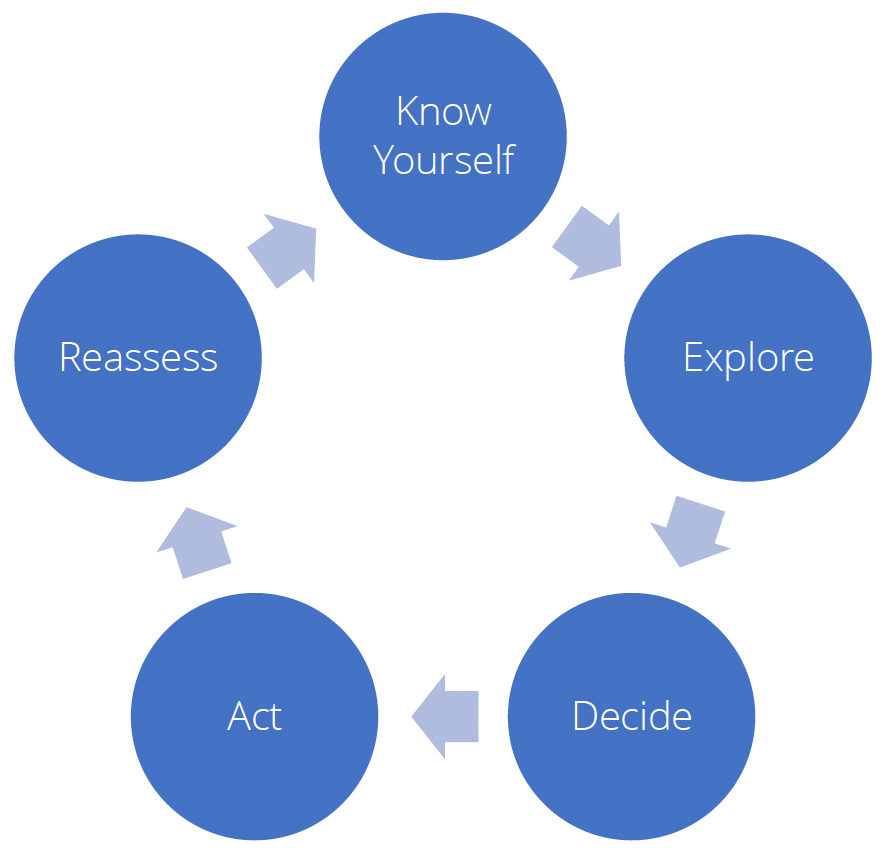
Instead of imagining a career as a choice you make once, you can conceptualize it as a recursive process or cycle with the following stages. You will likely complete multiple cycles of career exploration in college, and many more throughout your lifetime. As your identity develops and changes, so might your career.
-
Know Yourself: Gain a sense of self-awareness and understand your natural strengths, weaknesses, talents, values, and interests.
-
Explore: Build knowledge of the positions and industries available in the world of work. This also includes on-campus opportunities for exploration such as student organizations, leadership, and research.
-
Decide: Use your best judgment to select a course of action based on what you reflected upon and explored in the previous steps.
-
Act: Try out careers through jobs, internships, volunteering, or co-curricular activities. In this stage, you may also declare your major and build your network of professional contacts.
-
Reassess: Pause, reflect, and determine if you successfully integrated your self-knowledge with your knowledge of the world of work. If you are satisfied with the path you chose, you can continue building the knowledge and skills needed for your field. If you were unsatisfied, you can use your experiences to shift course and re-enter the cycle of career exploration.
Reflection Prompt
Where do you see yourself in the cycle of career exploration? What does the next stage look like for you?
1. Know Yourself: Build Self-knowledge
Think about who you are as a person and take some time to write down what you know about yourself.
The following prompts can help you get started.
- What do you like?
- What do you dislike?
- What interest you?
- What bores you?
- What type of people do you like to spend time with?
- What environments do you prefer?
- What are your values?
- What are you good at?
- How do you like to spend your time?
- What shows do you like to watch? What social media do you follow?
- What books do you like to read?
Reflection Prompt
What special qualities do you like about yourself? What would you like to be better at? What career areas would you still like to explore?
2. Explore: Understand the World of Work
Exploring the world of work means thinking about the careers and industries you are aware of andmgaining exposure to those you are not yet familiar with.
Career exploration can take many forms.
- Take Inventory of What You Already Know: about industries and professions. Note where there are gaps, assumptions, and possible misinformation in your current career knowledge.
- Get Involved on Campus: University programs and student-run organizations are just some of the ways that you can gain exposure to career fields. There are likely many places where you can seek out other students who share some of your interests and learn more about career-related topics.
- Conduct Online Research About Industries and Professions: you are interested in learning more about. To help you fill in gaps with accurate, timely information, consider researching careers of interest using sites provided in the Resources section of this guide.
- Observe the Careers of People Around You: including family, friends, and community members. You may be surprised to learn how many different types of work there are.
- Set Up Informational Interviews: with professionals in your fields of interest. You can ask about a typical workday, the person’s likes and dislikes about their job, and any other questions that will help you evaluate a certain career path
Reflection Prompt
What curricular and co-curricular activities am I aware of? Am I interested in participating in these activities? If so, in what ways? What careers/industries do I know about? What do I know about them? Where does this information come from? Is the source reliable? Do I need to do more research? On what?
3. Decide: Select a Course of Action
At this point, you have improved your sense of self-awareness as well as your awareness of the world of work. You are now prepared to apply your knowledge by making a decision about your next steps.
Depending on your individual situation, you might need to decide:
- What classes to take and what major to choose
- Whether to change your major
- Whether or not to continue exploring a particular career path
- What to do to continue learning about a field of interest
- Which job or internship to pursue
There are many ways to make career and life decisions, and each person will be unique in their process. Most people will either utilize an intuitive or analytical approach.
Intuitive Approach
Intuitive decision-making relies on a combination of one’s past experiences and personal values. An example of this could be a prospective student who enrolls at Marquette because they just “had a feeling” while they were touring campus. Intuitive decision makers might be drawn to values, relationships, and instinct.
Analytical Approach
Analytical decision-making focuses on the facts and figures. An example of this could be a prospective student who tours Marquette and compares their financial aid package, academic programs of interest, and social environment of Marquette to other schools under consideration before deciding. Analytical decision makers might be drawn to data, rankings, and objective information.
Learn more about Decision Making.
Reflection Prompt
What is a time in the past you have made a difficult decision? How did you go about it? What was the outcome of the difficult decision? Looking back, would you make the same choice? What did you learn about yourself?
4. Act: Try Things Out
To make informed career decisions, you must test your career ideas to confirm that you are progressing along a viable career exploration path. Testing your ideas will help you learn more about a given field and dispel or confirm the information you have gathered prior to beginning the experience. You can test your career ideas in a variety of ways.
Consider
- Taking classes that align with your career interests
- Joining a student organization related to your field of interest
- Seeking relevant part-time employment
- Applying for internships to gain career-related experience
- Reading books, magazines, and articles about the field
- Conducting informational interviews with established professionals
- Speaking with your professors about your career interests
If you need assistance in pursuing any of the above experiences, consider making an appointment at the Career Center. The Career Counselor meeting with you can support you as you make your unique career exploration plan.
Reflection Prompt
What ways are best for me to explore my career options?
5. Reassess: Evaluate Your Progress
After you seek out an experience, you will need to take some time to reflect on what you learned.
- If you like to write, you could journal about what your thoughts, feelings, and experiences were.
- If you like to reflect in the company of others, you might reach out to friends, parents, partners, or roommates to debrief.
A Career Counselor can also help you make meaning of your experiences. Taking time to process all of the information you have gathered will help you proceed with the necessary forethought that underpins meaningful progression in your career development.
Repeat the cycle…
After you engage in self exploration, learn about the world of work, and test out your career interests, you may need to repeat the cycle multiple times. If you find that your initial exploration was satisfying and helped you move closer to your goals, you can seek additional experiences associated with that career path. If you find that your exploration was not satisfying and did not address your goals, you can continue the process by re-examining yourself, the world of work, and possible opportunities for career-related experiences.
Reflection Prompt
Do I need to change course? How do I know that? Where should I start again?
Next Steps
Now that you have learned about the career exploration process, you may be ready to make decisions to learn more about yourself and the world of work. These can be expressed in next steps or goals, depending on how you like to think about them. When you consider what you would like to do moving forward, make sure your goals are SMART: Specific, Measurable, Attainable, Realistic and Timely.
You can also identify your system to work towards each goal, as well as your motivation to remind yourself of the importance of addressing your next steps.
Consult the example below to see what a goal associated with a system and motivation might look like.
- Goal: Be able to do 10 push-ups in a row by the end of the school year.
- System: Attend at least 1 strength-building group exercise class each week.
- Motivation: Moving into a new apartment will be much easier if my arms are strong enough to carry heavy boxes and furniture.
Use the Goal/System/Motivation technique to consider your next steps and why those steps are important to you and your progress.
How the Career Center Can Help You
The Career Center can help you with your career exploration process. Career Counselors are available to meet with you 1-on-1 as you make decisions about your career path. A Career Counselor will partner with you to determine your needs and create a plan that helps you progress. You can also speak with a Career Counselor about personality assessments that may address your unique situation.
Resources
Understanding yourself
Understanding the world of work