

- Schedule an Appointment
- Major/Career Exploration
- Internship/Job Search
- Graduate/Professional School
- Year of Service
- Resume and Cover Letter Writing
-
-
HANDSHAKE

-
CONNECT WITH US



-
PROBLEM WITH THIS WEBPAGE?
Report an accessibility problem
To report another problem, please contact career.center@marquette.edu
Professional Formation Competencies: Interview Questions
The National Association of Colleges and Employers's (NACE) career readiness competencies and Marquette University's guiding values inspired Marquette's Professional Formation Competencies. Because many employers seek these competencies in candidates, this guide can help you prepare effective responses for interviews.
The STAR method is one strategy used to answer these questions:
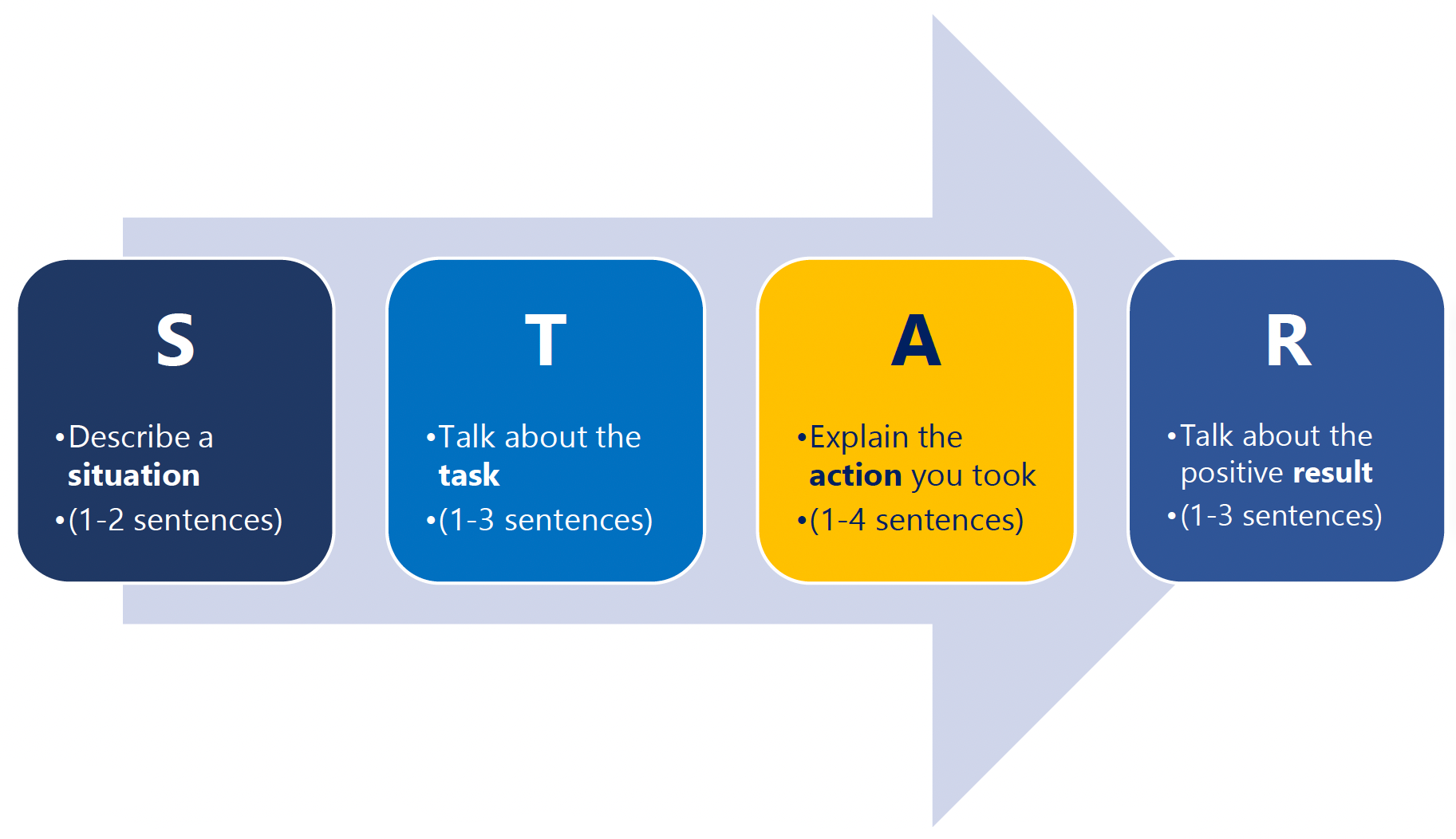
- Situation: Describe context
- Task: Identify challenge
- Action: Explain action
- Result: Show positive outcome
What follows is an example of the STAR method.
Question: "Tell me about a time when you have demonstrated initiative."
Answer: "Last summer I worked for a small warehouse. I found out that a large shipment was due in a couple of weeks and that there was very little space available for it (situation). The rear of the warehouse was disorganized and the inventory system was outdated (task), so I came in on a Saturday, figured out how much room was needed, cleaned up the mess in the rear and catalogued it all on new inventory forms (action). When the shipment arrived, the truck just backed in. There was even room to spare and the new inventory system saved us a good deal of time (results)."
Jump to Competency Questions
- Problem Solve with Curiosity
- Develop Career Management Skills
- Collaborate for Solidarity
- Communicate Responsibly and Ethically
- Lead for the Common Good
- Commit to Justice, Equity, and Belonging
- Adapt in Discipline and Technology
- Back to Career Guides
Problem Solve with Curiosity
You address complex issues with curiosity and creativity using experience and understanding to create solutions informed by the practice of lifelong learning. You work for and with others in evaluating and proposing actionable solutions that advance objectives using discernment to address implications with a focus on ethics, lasting impact, and the common good.
Remember to use STAR to give specific examples from your experience.
Questions
- Describe a difficult situation or a challenge you faced involving good judgement and positive outcomes involving others.
- Tell me about a time when you set a goal and were able to achieve it, focusing on the obstacles you encountered and how you worked through them.
- Tell me how you have used critical thinking to find effective solutions to a problem.
- Tell me how you have approached solving a problem using personal curiosity and creativity.
- Describe what you think critical thinking is and explain how you have used it.
Develop Career Management Skills
You develop career management skills and are self-aware, using that understanding of self to intentionally progress in your career. You advocate for yourself, commit to professional improvement, and prioritize time to quiet your mind to hear your inner calling. Through this work and time for reflection you move through your career with attention to and momentum toward personally meaningful work.
You might use STAR to give specific examples from your experience.
Questions
- Why are you interested in this position with our company/organization?
- How does this position fit with your personal and professional goals over the next few years?
- Consider a time when you worked hard to succeed and identify values that motivated you.
- How do you set professional goals to advance your skills and improve?
- What aspects of this role specifically interest you? What aspects of the role are less exciting?
- How does this role tie to your values and personal/professional goals?
- What kind of work environment do you need to be successful?
Collaborate For Solidarity
You collaborate for solidarity knowing your unique abilities and placing importance on continually learning about and from others. You understand how to be an effective contributor and respect the contribution of others. You can successfully resolve conflict with the involved parties. The priority is working for the good of the group and acting as a person for and with others.
Remember to use STAR to give specific examples from your experience.
Questions
- How have you leveraged different perspectives and strengths on a team to effectively complete a project?
- Tell me about a time that you have worked collaboratively with a team toward a common goal.
- At times, there can be disagreements in a team setting. Can you tell me about a time your opinion differed from a teammate and how you reached a conclusion?
- What is your approach to working in a team? How do you go about building rapport with other individuals in the team?
- How do you learn about the various strengths of different team members to ensure you are working effectively together?
Communicate Responsibly and Ethically
You can communicate successfully by engaging as an active listener and thoughtful speaker; take responsibility for public expression; act ethically when using digital communication; and are adaptable with virtual interactions. You demonstrate confidence and skill in different forms of communication. Your contributions are supported by evidence and truthful. You approach communication with curiosity and put effort toward reaching understanding.
Remember to use STAR to give specific examples from your experience.
Questions
- Tell me about a time you had a disagreement with a colleague/supervisor. How did you communicate with that individual that displayed responsibility and honesty?
- Tell me about a time when you interacted with someone who was not being truthful or ethical; how did you respond?
- Tell me about a successful presentation you gave and why you think it went well.
- What does two-way communication to you? When is an example of a time you have used two-way communication?
- Explain how you interact with others in a virtual meeting setting.
- What is most important to you when interacting with others on social media?
Lead for the Common Good
You demonstrate leadership through self-initiative and the empowerment of others to advance solutions for the greater good of all. You seek diversity of thought and strengths, advocate for others, and encourage growth while exercising sound judgement and accountability. You address challenges with knowledge, confidence, and empathy.
Remember to use STAR to give specific examples from your experience.
Questions
- Tell me about a time you demonstrated leadership skills that displayed sound judgement.
- Tell me about a time that you demonstrated effective leadership skills by leveraging your team’s strengths.
- What are you looking for in a supervisor? Think of someone in an authority role who treated you well and describe the qualities that made that relationship productive.
- How would you describe your leadership style?
- Can you tell me about a time as a leader you have advocated for your team's needs?
- How do you ensure you are practicing sound judgement when making decisions on a professional team? Tell me about a time where, as a leader, you addressed a sensitive issue with others?
Commit to Justice, Equity, and Belonging
You commit to ongoing learning about justice, equity, and belonging, appreciating the unique contribution of all people. You understand internal and external biases and use this understanding to influence the building of environments with equitable policies, procedures, practices, and culture. You draw attention to injustice and advocate for others, even when it is not easy to do so. Here at Marquette, our work in its entirety is guided and informed by our Catholic, Jesuit mission to serve God by serving our students, faculty and staff. Those who are part of our educational mission are asked to build a community of belonging.
Remember to use STAR to give specific examples from your experience.
Questions
- Working with people from diverse backgrounds and cultures can present unique perspectives for collaboration. Describe a time where a project or decision was enhanced by including diverse perspectives.
- How do you contribute to an inclusive environment?
- Can you tell me about a time when you worked to understand the perspectives of others?
- Describe a time where you helped to address an injustice or advocate others?
Adapt in Discipline and Technology
You are aware of the tools and technologies needed to perform well in your discipline. You work to become proficient in those tools and place importance on learning new tools and technologies as they emerge. You have agency to create solutions to problems and advance your profession.
Remember to use STAR to give specific examples from your experience.
Questions
- Sometimes projects do not always turn out how we anticipate them to. Tell me about a time that you had to adapt your approach to a task or project to create a strong solution.
- There are always new and emerging products and technologies to improve the workspace. Can you tell me about a tool that you have used that has improved your efficiency?
- What tools or technologies are needed for this position and how have you utilized them in a previous experience?
- What have you done outside of the classroom setting to learn a new skill related to your career goals?